
















What Are Hackviser, TryHackMe and HackTheBox? Differences, Prices and How to Use Them
Three names every beginner in cybersecurity meets first: Hackviser, TryHackMe and HackTheBox. All promise hands-on learning, but their audiences, difficulty levels and prices differ.
This post contains personal advice for beginners and was not written for commercial purposes. If you think any of the content is wrong, get in touch.
Before reading this post, please do a little research on what a CTF is and why we solve CTFs. If you know nothing about it, this video may interest you. Youtube
There are three names everyone who wants to start in cybersecurity meets first: Hackviser, TryHackMe and HackTheBox. All three promise “hands-on learning”, but their target audiences, difficulty levels and prices differ. Starting with the wrong platform can put you off instead of making learning easier.
If you have not read about the Siber Vatan Program yet, I recommend looking at it first, because one of the platforms in this post is directly that program’s training infrastructure.
First, let’s settle one question: why do we solve labs?
Cybersecurity is not a field you learn by watching videos. You cannot move forward by studying concepts and taking notes the way you would for an exam. You need to learn by trial and error in live test environments. Lab platforms solve exactly this: they give you a target that is deliberately vulnerable, isolated and legal. You practice without building your own system and without taking any legal risk.
Important: Apart from these platforms, do not test any system you do not have permission for. In Türkiye this falls under Articles 243–245 of the Turkish Penal Code, and the defense “I was curious, I just tried” does not work. Lab platforms are not only a place to practice, they are also a boundary that keeps you on the legal side.
1-Hackviser: Türkiye’s local platform that is also global
This initiative, born within Siber Vatan, keeps improving itself and adding new scenarios and training content. Recently, new certificate options with international validity were added to the platform. Thanks to the discounts offered to Siber Vatan participants and students, you can reach certificates that document your knowledge and skills in the field at very affordable prices.
There are two ways to sign in. If you sign up as a normal member, the global interface opens and the content is in English. If you sign in with Siber Vatan, the content is in Turkish. The platform covers both the offensive and the defensive side and aims to build hands-on cybersecurity skills. Developed within CYROPS Cybersecurity, the platform is also used as the official training platform of the Siber Vatan Program.
Content structure:
- Warmups: Three-stage introductory content for people just starting machine hacking
- Labs: Topic-based work focused on a specific subject
- Scenarios: Story-driven scenarios with realistic vulnerabilities
- Trainings: Structured, step-by-step training
- HackerBox: A ready-made attack machine that runs in the browser (no need to set up your own Kali)
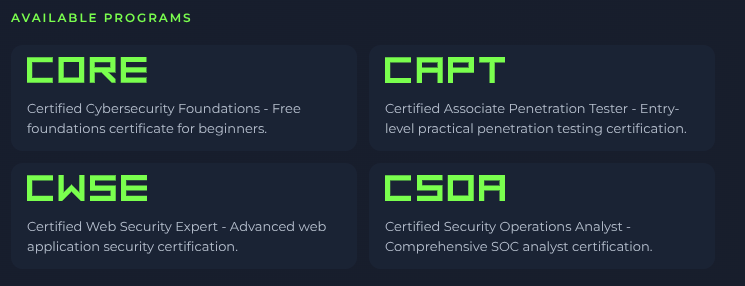
Certificates: CORE (free, entry level), CAPT (penetration testing entry), CWSE (web security), CSOA (SOC analyst). All are awarded through hands-on exams.
Pros:
- Turkish content, the biggest advantage for those whose English is weak
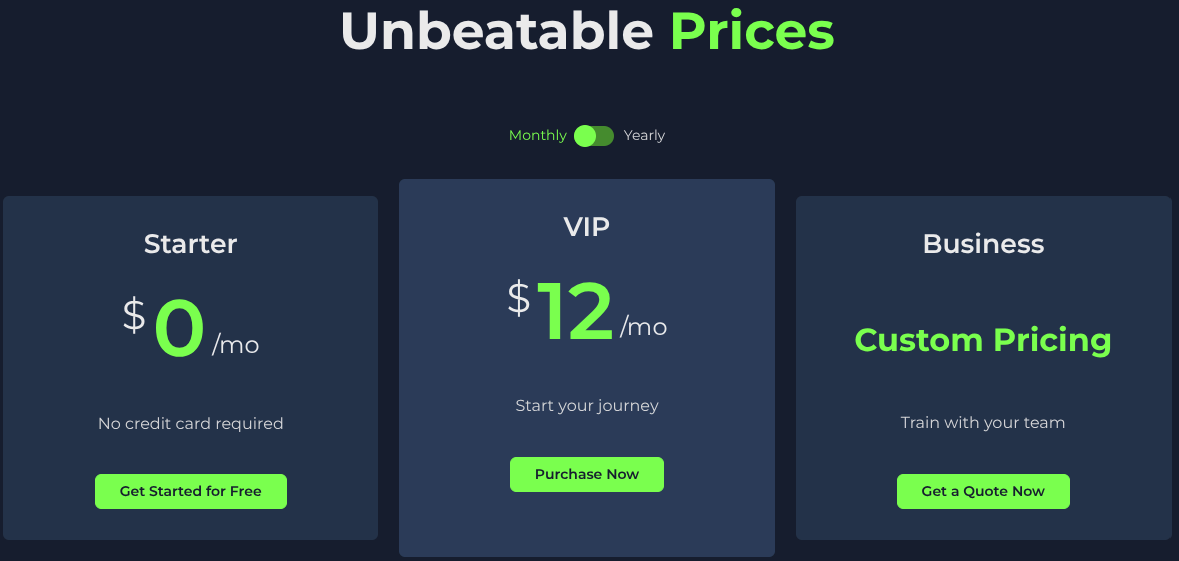
- The free plan is genuinely usable, not at “advertisement” level
- If you are accepted into Siber Vatan, the VIP plan is given free for 7–9 months
- Raises your recognition among organizations in Türkiye (on the public sector and defense industry side)
Cons:
- The content pool is smaller than TryHackMe and HTB (still growing)
- Does not yet carry the same weight in international job applications (still growing)
- The community (Discord, writeup ecosystem) is smaller
Who it is for: Anyone living in Türkiye who is new to cybersecurity and thinking of applying to Siber Vatan. First choice as a starting point.
2-TryHackMe: The most classic and popular
A well-established standard in the industry for many years, one that everyone starting cybersecurity has heard of at least once.
Standout features:
- Learning Paths: Routes planned from start to finish, such as “Pre Security”, “Jr Penetration Tester” and “SOC Level 1”
- AttackBox: A ready-made Kali machine that opens in the browser, so you can work without setting up a VPN
- King of the Hill (KoTH): A competitive hacking game against other users. You take over a machine and patch it so that others cannot get in
- Certificates: SEC0 (Pre-Security), SEC1 (Security 101) and SAL1, which carries weight on the blue team side
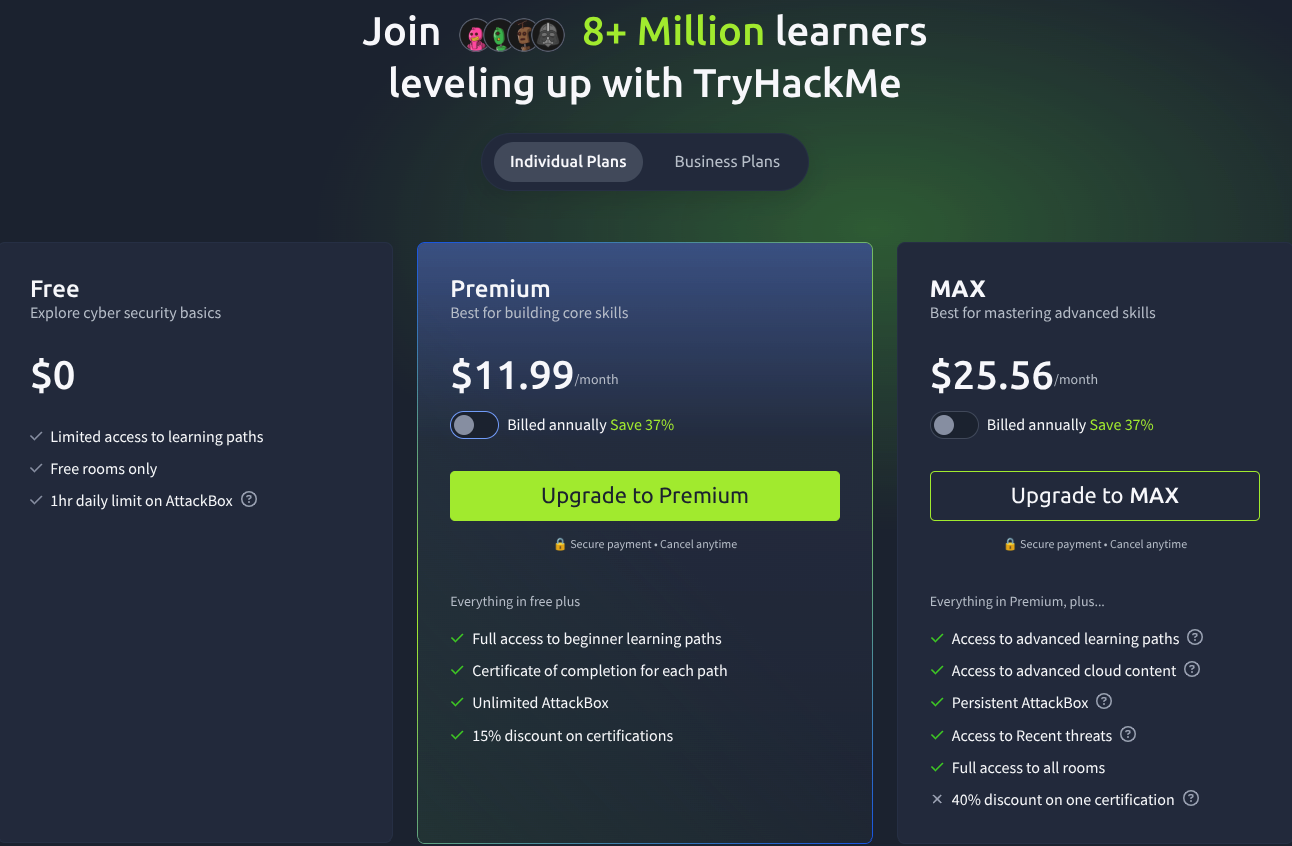
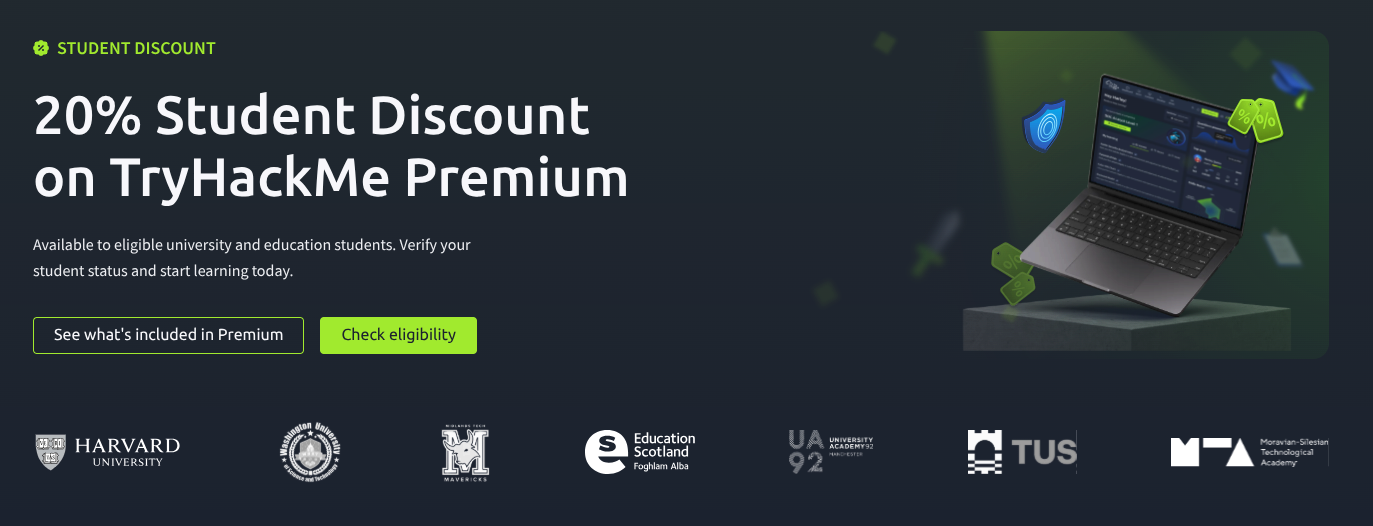
Student discount: Annual subscriptions get a 20% discount. It is valid only on the annual plan, not on monthly, and it does not apply to the MAX plan. If you enter your student details in the “Occupation Details” section of your account settings, the discount is applied automatically on the payment page.
Pros:
- The gentlest learning curve for beginners, with difficulty increasing step by step.
- No worry about which lesson comes next, because the order is already set.
- The free content alone lasts for months and lets you lay a solid foundation
Cons:
- Being so guided becomes a disadvantage after a point: it does not push your independent thinking hard enough. And while we are on the subject, avoid using AI as much as possible when solving labs. Finishing a lab and moving forward feels good, but you lose your real problem-solving ability. If you have to, spend hours, but do not look at the answer and do not use AI.
- The content is entirely in English (if you force yourself to avoid translation as much as possible, this is even an advantage, and your professional English can improve too)
- AttackBox time limits on the free plan are sometimes insufficient on the free tier.
Who it is for: People who want to strengthen the basics, people thinking about a SOC/blue team career, and people starting from zero. In short, everyone.
3-HackTheBox: More detailed, harder labs.
Important note: I have not had the chance to experience the platform fully myself. I wrote this based on research. If you think anything is missing or wrong, get in touch and we will fix it
HTB’s most distinctive feature is that as you progress, it pushes you from guided learning toward independent problem solving. In options such as Starting Point and Guided Mode you can get step-by-step support. In the classic Adventure Mode, however, you are given a target machine and are expected to work out largely on your own how to reach the user/root flags. Especially at intermediate and advanced levels, this structure offers an experience closer to the independent research process of a real penetration test. There is one confusing point here, so let’s clarify it right at the start: HTB Labs and HTB Academy are two separate products with two separate subscriptions.
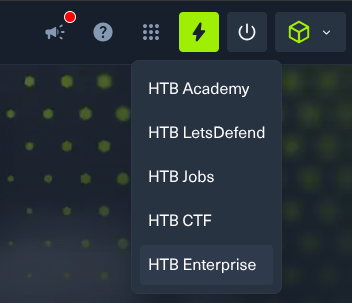
HTB Labs (Machines and Challenges)
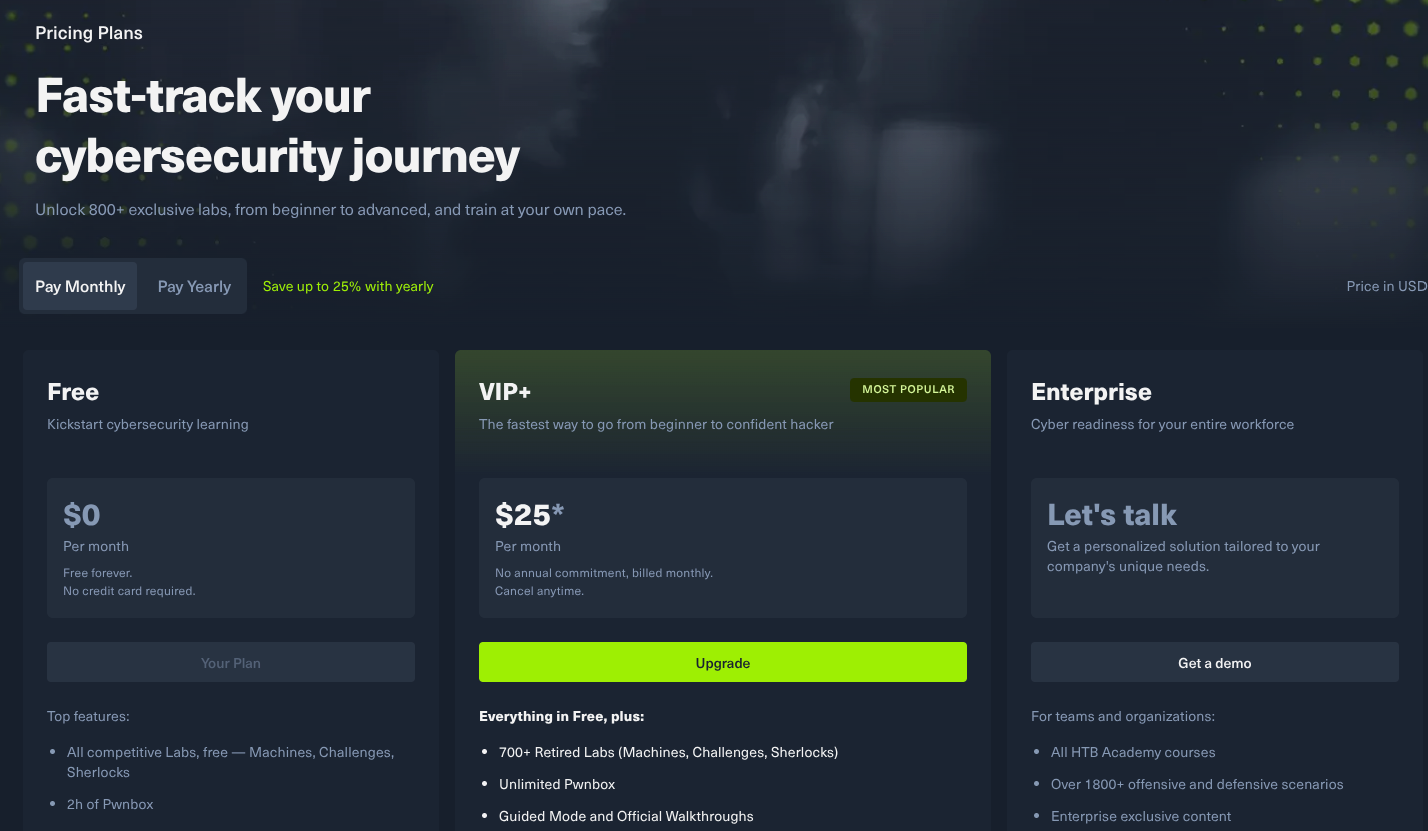
Note: The old VIP plan is now closed to new purchases. After October 2025 only VIP+ is sold. Existing VIP subscribers can renew their plans, but if they cancel they cannot come back.
HTB Academy (Structured modules)
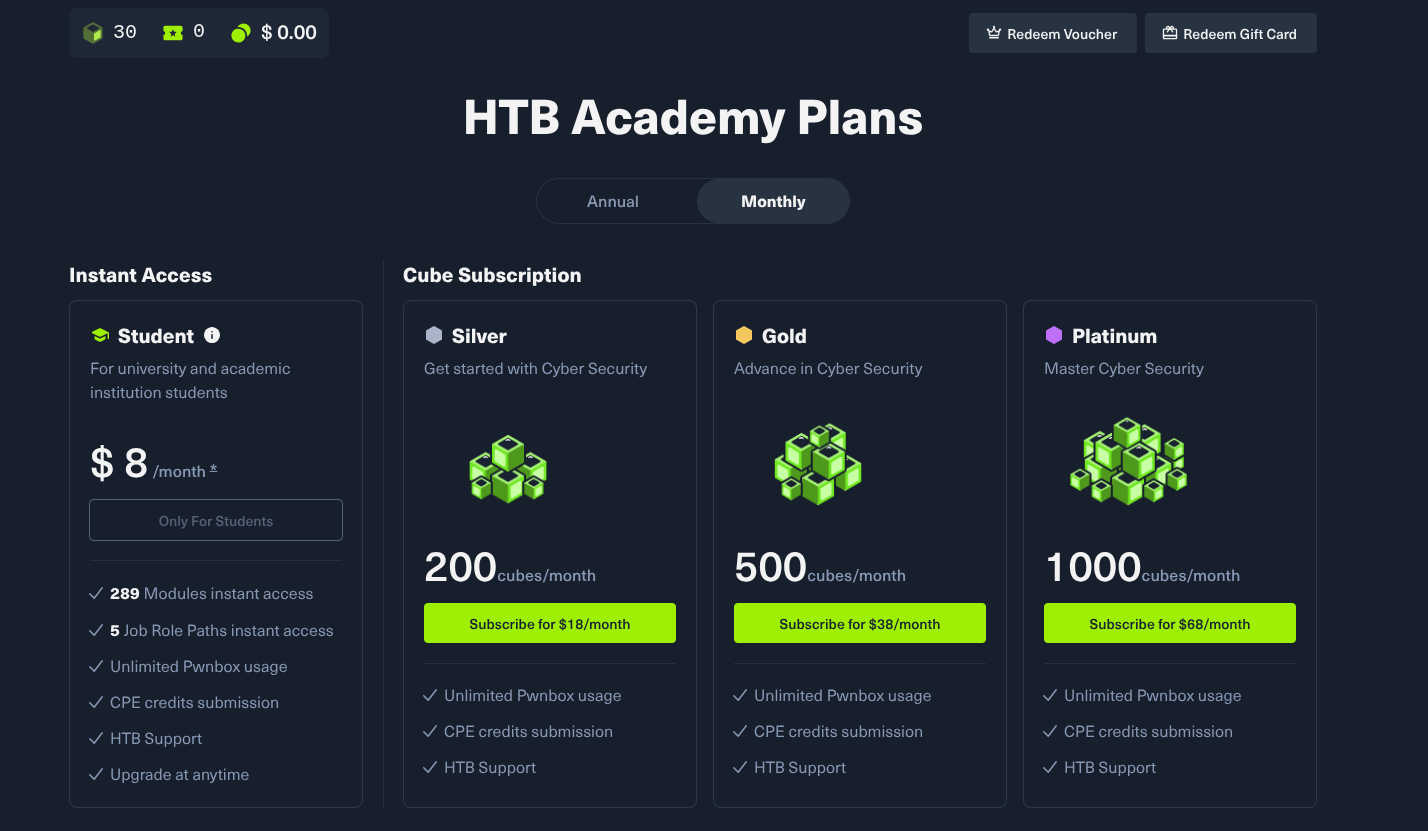
Unlike Labs, here there are theory + hands-on modules, accessible from the browser. It is sold under two different models:
- Cube-based: Cubes are loaded into your wallet monthly, and with the cubes you spend you unlock a module permanently. Silver $18, Gold $38, Platinum $68.
- Access-based: All modules in the relevant tier are open for the duration of the subscription.
- Student plan: $8/month ($96/year), with access to Tier I and II modules. This includes the Web Penetration Tester, Penetration Tester, Junior Cybersecurity Analyst, AI Red Teamer and SOC Analyst paths.
For the student plan you do not need to change your account. It is enough to add your school email as a secondary email. If your university domain is registered in the system, the plan opens instantly. This is the best price/performance ratio in the industry. If you have a university email, there is no reason not to use it.
Certificate: CPTS, a hands-on certificate that carries serious weight for penetration tester positions.
Pros:
- The strongest signal for offensive security on the hiring side
- Academy’s student price is incredibly good
- With the cube system, the module you buy stays yours permanently
- A huge community and writeup ecosystem
Cons:
- There are labs for beginners too, but the general view is “start with TryHackMe, move to HTB later”, so it may not be the best option for a start.
- When you buy Labs + Academy together, the monthly cost rises to the $20–40 range
- Pro Labs is separate and expensive
Summary:
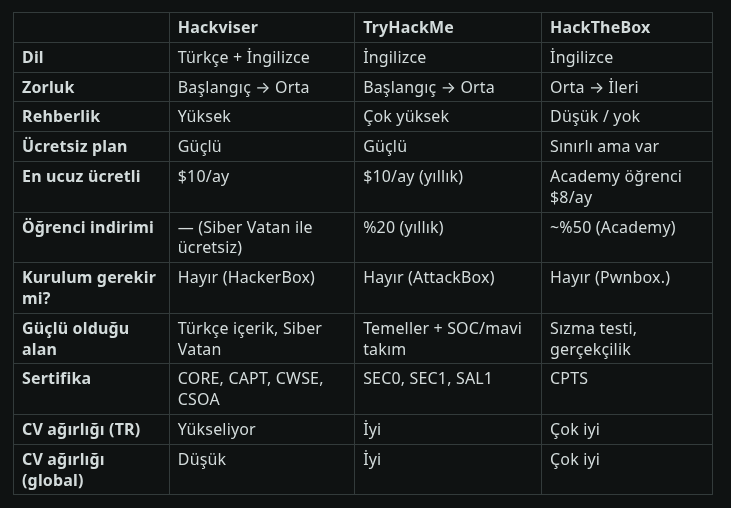
So how should I use them?
Take your time and move forward step by step, understanding as you go. Do not treat it as a chore. Try to get the same pleasure you get from solving a puzzle.
Months 0–2, Foundation: Hackviser (free) + picoCTF
- Also, this site, which is older than almost everyone reading this post (2004), may interest you: CTF
- Finish the Warmups with the Hackviser Starter plan
- We have not mentioned picoCTF at all, but I think it is the ideal CTF platform for beginners. Please check it out too.
- Settle your Linux command line and basic networking knowledge (ip, netstat, nmap, file permissions, services). Hackviser has very good tutorial articles, and they are in Turkish. Understanding the basics in your native language will be meaningful at the start.
- In parallel, solve picoCTF, especially the “General Skills” and “Web Exploitation” categories
- Do not pay for anything at this stage.
Months 2–7, Structure: TryHackMe
The goal is to make your knowledge systematic.
- Start with the free rooms, and when you are sure you will really continue, buy an annual premium plan (with the student discount)
- If your goal is the offensive side, finish the “Jr Penetration Tester” path from start to end; if it is the defensive side, finish “SOC Level 1”
- Write your own notes after every room, and do not skip this step
After month 7, Going deeper: HackTheBox
The goal is to prove that you can solve problems on your own.
- In Labs, first finish the free Starting Point machines
- When you feel comfortable, move on to “Easy” level retired machines. They have writeups you can look at when you get stuck
- Once your goal is clear, prepare for CPTS
Run in parallel at every stage: Siber Vatan
If you are accepted into Siber Vatan, the Hackviser VIP plan comes free for you for 7–9 months. In other words, content you would normally pay $10/month for is free. So do not miss the application period, and do your CTF practice before applying.
Practical Tips
1. Make note-taking a habit. If you have not used Obsidian, it is a very solid note-taking app. Together with AI, notes in .md format are now almost a necessity in our lives, and if you start a blog later you can publish the md files directly on your own blog. For every machine you solve, take notes in the format “which vulnerability, which tool, which command, where I got stuck”. As notes accumulate and the connections between them grow, a structure like neural connections will form and keep you more motivated.
2. Write and publish writeups. This both reinforces your learning and becomes concrete proof on your CV. Employers read this more than certificates. (Publishing solutions of some machines is forbidden, so please check.)
3. Do not rush when buying an annual plan. Pay only after being stuck on a platform for free for at least 3–4 weeks. The free tier labs are quite enough to get used to the ecosystem. Consider buying only when there are no labs left to solve.
4. Use your student email. Both TryHackMe and HTB give student discounts, and these discounts are significant. Not taking advantage of these prices while at university would be a big loss.
5. One platform at a time. To avoid burnout, move forward step by step as you learn.
6. When paying from Türkiye, because of your card limit and the exchange rate, annual plans work out noticeably cheaper than the monthly total. If you have made up your mind, buy annual. (Please finish all the free tier labs first)
Conclusion
For those who want a short answer:
- If you are starting from scratch: Hackviser (free) + picoCTF
- If you want to settle your fundamentals systematically: TryHackMe
- If you want to really challenge yourself and find a job: HackTheBox
- If you are a student in Türkiye: Apply to Siber Vatan, get Hackviser VIP for free, and put the rest of your budget into the HTB Academy student plan
These three platforms are not rivals, they continue one another. If you use them in the right order, within a year you can go from “a student curious about cybersecurity” to “a hireable candidate”.
⚠️ Note: Prices and plan contents change often (they may also differ by region and exchange rate). Before paying, be sure to check the platforms’ own pricing pages: hackviser.com/pricing · tryhackme.com/pricing · hackthebox.com/pricing
Also published on: ABT ↗